THE AMAZING WORLDS OF JOHN B. ROSENMAN – 4 Books, 600 Pages. #Scifi #Paranormal – Featuring Preditor’s & Editor’s prize-winning story, “The Blue of Her Hair, the Gold of Her Eyes.”
Monday, March 21, 2016
Wednesday, February 17, 2016
WELCOME MARINA JULIA NEARY
A self-centered, only child of classical musicians, Marina Julia Neary spent her early years in Eastern Europe and came to the US at the age of thirteen. Her literary career revolves around depicting military and social disasters, from the "Charge of the Light Brigade," to the Irish Famine, to the Easter Rising in Dublin, to the nuclear explosion in Chernobyl some thirty miles away from her home town. Notorious for her abrasive personality and politically incorrect views that make her a persona non grata in most polite circles, Neary explores human suffering through the prism of dark humor, believing that tragedy and comedy go hand in hand.
Her debut thriller "Wynfield's Kingdom" was featured on the cover of the First Edition Magazine (see above) and earned the praise of the Neo-Victorian Studies Journal. After writing a series of novels dealing with the Anglo-Irish conflict - "Brendan Malone" (2011), "Martyrs & Traitors" (2011) and "Never Be at Peace" (2014), she takes a break from the slums of London and the gunpowder-filled streets of Dublin to delve into the picturesque radioactive swamps of her native Belarus. "Saved by the Bang: a Nuclear Comedy" is a deliciously offensive autobiographical satire featuring sex scandals of Eastern Europe's artistic elite in the face of political upheavals.
1. Welcome, Marina. It's good to have you as a guest. I tend to ask profound and probing questions, so I'd like to start by asking you why you named your blog CT Commie Tiger Mommy.
Even after 24 years in the US, I don't quite fit with the "soccer mommy" crowd of Southern Connecticut. My crude sadistic jokes make me a bit of an outsider. So I use my pariah status to my advantage. I just haven't gotten the whole heterosexual Stepford Wife thing down. I'm not good at playing golf or staging fits of maternal guilt. When my son was born, I stuffed him in daycare and was like . . . "Later!" When I tell people I didn't feel one ounce of guilt about leaving my baby in the care of "glorified babysitters", they look at me like I have two heads. Referring to myself as a Commie is in the same vein as an African American person using the "n" word.
2. Tell us a little about your newest novel Never Be at Peace (see cover above). For example, how did you come up with the title and what is your main character Helena Molony like? Is she similar to you?
Never Be at Peace is actually the last in the 1916 trilogy. The original title was Tears of Emer, because Emer was Helena's stage and pen name. In addition to being an actress she was also a journalist. She was theatrical, aggressive, bisexual and alcoholic. An incurable idealist who lived to see all her dreams perish, she's a very poignant and unfairly underrepresented historical figure. Never Be at Peace was actually my husband's idea. It's a line delivered by Patrick Pearse at the graveside of a Fenian, "Ireland unfree shall never be at peace". Well, guess what? Even after gaining freedom, Ireland was still not at peace for a long time. That's the irony of it.

3. Never Be at Peace has an earlier companion piece. When you wrote Martyrs and Traitors (see cover above left), did you know you'd be writing a sequel? Is there a close bond between the two?
Martyrs and Traitors was written over the course of 4 months and turned out to be a whooping 450+ pager. The focal figure is Bulmer Hobson, a controversial Protest born hero, Helena's lover-turned-enemy. They had a turbulent political and romantic bond, and eventually had a falling out due to ideological differences. Helena favored the idea of an open insurrection, even if it had no chance of military success, while Bulmer actually tried to stop the Easter Rising of 1916. I had the biggest crush on Bulmer for a long time, to the point of seeking out his surviving family members and getting previously unpublished photos of him. I must say, skinny, vitamin D deprived Irish revolutionaries are my weakness!
I was less than 30 miles away from the epicenter of the disaster. Comedy is in the eye of the beholder. When you see your classmates dropping of radiation poisoning and leukemia, you can either cry or laugh. I believe that comedy and tragedy go hand in hand and feed off each other.
5. You've been called abrasive and offensive. What are a few of your traits or politically incorrect views that rub people the wrong way?
People don't know what to make of me. On one hand, I'm not entirely heterosexual, yet I'm in a monogamous relationship with a man, and have been for the past 18 years. My first great love was a girl, and I got into a lot of trouble for it, living in a very homophobic society. Eventually I conditioned myself to like boys, even though they did not like me very much. The funniest thing is that I snagged a great guy, the kind that any heterosexual soccer mom would love to have for a husband. I have successfully robbed the heterosexual community of a great male specimen. That perplexes the GLBT community, who think that I'm still "in the closet" or I "sold out to patriarchy". I'm also an ardent pro-life activist. Gee, that cost me a few phony friendships on Facebook. I am very open about not liking children very much, yet I defend their right to life. I also joke about getting arrested for breastfeeding my cats in public. People don't like to have their stereotypes challenged. They like everything pigeonholed.
6. When asked if there was anything specific you wanted to say to your readers, you said in part, "Try to disengage from your American mentality." Why should Americans do this?
It really means, step outside of your comfort zone, of your Walmart realism. The paradox is that America is such a melting pot, yet the mainstream has the propensity for blandness and narrow-mindedness.
7. You said in an interview that "It takes a Slavic artist to capture an Irish tragedy." Why?
Because Celts and Slavs are genetically similar. They have common ancestors. I think Eastern Europeans understand the Irish very well. Many Poles and even Lithuanians, who are not Slavs but have been influenced by Slavic neighbors, have found a new home in Ireland. The assimilation was rather smooth due to religious and psychological similarities.
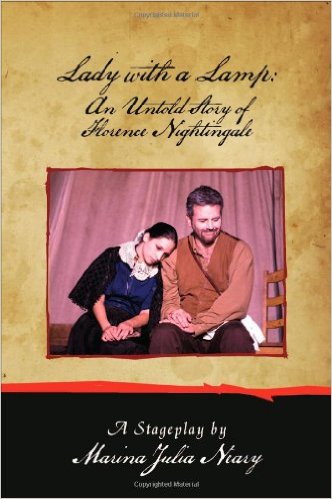
8. You've published two historical plays, Hugo in London and the sequel Lady with a Lamp: The Untold Story of Florence Nightingale (see cover above). Can you discuss a few things which aren't generally known about Florence Nightingale? Is she at all like Helena Molony?
So glad you asked about Florence versus Helena. Helena was an overt feminist and made a conscious effort to improve the lot of her Irish sisters. Florence, on another hand, did not care much for the lot of women. It was not her goal to advocate for them. She was actually advocating for the soldiers, who deserved quality medical care. Florence became an inspiration for many young middle-class women who were looking for an alternative to a life inside a parlor, but she was not primarily preoccupied with "advancing the lot of women".
9. Thank you, Marina for a great interview. Before you leave, could you supply readers with a few links where they can purchase your books and learn more about you?
My books are available on Amazon and
through my respective publishers. You can find me on Facebook and also visit my
blog: ctcommie.blogspot.com.
* * * * * * * * * *
Monday, December 14, 2015
Never too Late
John B. Rosenman
(Reprinted from The Write Room Blog. Valentine's Day!- A Collection of Members' Poems and Stories on Love and Romance, which can take many forms. My story's about people we often forget who are nearing the end of their lives. http://www.thewriteroomblog.com/?m=201502)
Andrew Delane hadn’t heard her voice in fifty-nine
years, but he recognized it in a heartbeat.
He paused with his hand on the door of the assisted living facilty
before leaving and then turned, blinking with surprise.
Surely he was mistaken. It was his imagination.
Then he heard the voice again and shuddered with
wonder. Hale, hearty, and at seventy-seven
years of age self-sufficient as the broken friend he’d just visited wasn’t, he
made his way across the day room until he discovered the voice’s source.
Six decades had ravaged and wilted the once fresh,
flirtatious girl who sat alone at a table, her face a mass of wrinkles. While others might not have recognized her,
Andrew had no trouble at all. To him,
she was as lovely as ever.
“Hello, Evvie,” he said.
She blinked and looked up. “Have we met?”
“Yes, long ago.
I’m Andy... Andrew Delane.” Before
he lost his nerve, he sat down at the table.
“What are you doing?”
Her knobby fingers turned something over—a
Valentine’s Day card. “To Grandmother
with Love,” it said.
“My grandchildren sent it to me,” she said. “My husband used to give me flowers and presents. He never forgot.” She sighed.
“But he’s been gone now seven years.”
So she was alone, just like him. He licked his lips. “I…once sent you a Valentine’s Day card.”
“You did?”
Yes,
and you liked me once, too. Liked me a
lot. Then you met the boy who became
your husband and forgot all about me.
Evvie was looking at him. “Excuse me, I don’t mean to stare. It’s just my memory isn’t so good anymore and
I forget things. What did you say your
name is?”
He held out his hand, his heart pounding. “Andrew Delane.”
She raised her own and placed it trembling in his. Parkinson’s perhaps.
“I’m Eveline Timmons.”
“Yes.”
She gazed at him, and for a moment sixty years passed
away, and he could almost believe she was the girl who had briefly liked
him.
“You’re nice, Andrew. If I can call you that.”
“You most certainly may, Eveline.” For the first time, he noticed other cards on
the table as well as envelopes. “What
are those?”
“These? Just
some Valentine cards I’ve meant to fill out and mail.” A flutter of embarrassment. “I’m a bit late.”
I
guess we both are. He
smiled and moved his chair closer. “Tell
you what. Suppose I help you a little.”
* * * * *
Monday, October 19, 2015
WELCOME CHRISTOPHER MANNINO, AUTHOR OF SWORD OF DEATHS
Chris Mannino
Chris Mannino is a versatile MuseItUp author who writes about Death and many other subjects in multiple genres. Below is the cover and an excerpt from Sword of Deaths, his most recent novel in the School of Death series. Also, you will find a riveting interview that I find both fascinating and surprising.
John: Hi, Chris, thank you so much for being my guest. I have to begin by asking about your picture on MuseItUp Publishing’s site. What’s a high school theatre and drama teacher doing with a scythe held over his shoulder? Are you auditioning for the role of the Grim Reaper?
Chris: Sword of Deaths is available now. I’m hoping the final novel Daughter of Deaths releases next year.
***ATTENTION: School of Deaths is on SALE this week for only 99 cents, and Sword of Deaths is also on sale for only $2.99.
EXCERPT from Sword of Deaths
Frank started to speak when a deafening shriek pierced the woods. They exchanged a silent acknowledgement, and crept to the side of the boulder.“We might be able to hide beneath the stone,” Frank told Michi. He used his mind, grazing the power without diving into its depths.The shriek screamed through the forest. The Elementals huddled on the rock’s edge, grasping for a crevice. Frank reached into his pocket and clutched the hilt of Rayn’s dagger. Tingles of warm energy coursed through his skin, rippling in waves from the mortamant blade.A third scream blasted leaves to the ground. The forest floor trembled and trees quivered in the face of the Dragon’s fury.“Something’s changed,” said Michi. “He knows we’re here.”“Don’t be ridiculous,” said Frank. For a moment the forest quieted.Crash!The canopy overhead tumbled down, trees snapping in half. A smell of sulfur choked Frank. A blast of heat swept through the forest. White-hot flames engulfed the woods, disintegrating trunks and leaves in a conflagration. Fire rushed around them like a tidal wave against a beach. The boulder protected their backs, yet even the stone grew hot. Smoke stung his eyes like acid.Frank pulled out the dagger. The Dragon’s scales covered its entire body. He’d never get close enough to draw blood. Yet, one nick of his own blood and he’d be home.The Dragon’s blast ceased. So much destruction in a single blast. How did the Deaths ever defeat creatures like this? Acrid smoke billowed around the ashen ruins of trees. A wide swath of forest had been obliterated.“Hold my hand,” he said. The boulder radiated heat behind them like coal in a furnace. “I’m going to bring us back to the College.”“Wait. I’ve used my power,” said Michi. “It’s two against one, we should fight.”“Fight a Dragon? Are you insane?” |
~ A CONVERSATION WITH CHRISTOPHER MANNINO ~
John: Hi, Chris, thank you so much for being my guest. I have to begin by asking about your picture on MuseItUp Publishing’s site. What’s a high school theatre and drama teacher doing with a scythe held over his shoulder? Are you auditioning for the role of the Grim Reaper?
Chris: One of my students was causing some
trouble, just thought I’d reap a quick soul. No, that’s a joke, of course. The
picture was actually taken when we filmed the trailer. A group of students (all
of whom have since graduated) joined me to film a book trailer. Some were
actors, and one kid did the camera work. The scythe was used in the trailer –
it is a steel scythe, not fit for soul reaping (real scythes, as my books
discuss, are made of mortamant).
John: Could you tell us more about
yourself? Why are you so fascinated with death (at least fictionally). And what
motivated you to write about Suzie, the first female Death in a million years?
Chris: The books were inspired by a trip
I took to Cornwall, while finishing a study abroad program in grad school. I
spent a semester at Oxford, and decided to journey once a week to a location
I’d never visited before. One of those trips led me to Tintagel, the supposed
birth-place of King Arthur. I became stranded there, not realizing there was
only one bus to/from Exeter a day, so had no car, little money, no change of
clothes, and no phone. I spent the night in a pub.
At 4 am, having slept
very little, I journeyed out onto Barras Nose, a promontory overlooking the
Cornish coast, and Tintagel Castle. I was alone, with no other people in sight,
fighting fierce winds from every direction. I crawled on all fours to avoid
being blown into the sea, and watched the dawn from a cliff, fifty feet above
the crashing waves. I imagined a character completely alone, attacked from all
directions. In the earliest draft, the character was actually a boy.
I liked the idea of
someone training to be a Reaper, since I was at the time training to be a
teacher. As I sought to make the character even more isolated, I developed the
idea of Susan being not just the only female reaper, but the first female Death
in millennia. I was drafting in Oxford, and the first time I felt homesickness
for the USA was Halloween- which is a huge holiday in the States, and felt like
nothing in England. That’s probably one reason the characters ended up carrying
scythes.
John: Is spooky YA fantasy your basic genre?
Chris:
Absolutely not. I’m currently working on edits for Daughter of Deaths,
the final book in the trilogy, but have already started my next novel, which is
in a completely different genre. The new novel is adult sci-fi thriller, sort
of Dan Brown meets Michael Chricton. I have many genres I want to explore,
including historical fiction, adult high fantasy, humor, and nonfiction. I keep
a detailed “book journal” with novel ideas, and there are currently twenty-two
ideas there.
John: Tell us about your School of Death
books, and please mention your adult science fiction novel.
Chris: The
Scythe Wielder’s Secret is a trilogy that begins as lighter YA Fantasy, and
ends with a dark and epic feel. The first novel, School of Deaths, tells the story of a thirteen-year-old girl who’s
forced to become a Death, and reap souls. She’s the first female Death in a
million years, and fights against sexism and bullying, eventually helping to
overthrow the headmaster of the school.
In the second novel, Sword of Deaths, we continue to follow
Susan and her friends, as they struggle to prevent a war between Dragons, who
are the original reapers, and Deaths. The three search for the fabled First
Scythe, which they hope will change the balance of power.
In the final novel, Daughter of Deaths, war breaks out, and
Susan and her friends are caught at the heart of a terrible secret. For the
first time we learn the real reason that Susan was brought to the World of
Deaths, and the fate of three worlds rests on her shoulders.
I’m not going to go
into too much detail about the newest novel I’m working on now, but I’ll say
it’s been fun to switch genres. Writing from the point of view of adults is a
nice change. It also starts in Washington DC, which is not only a popular spot
for thrillers, but is also my home.
John: Do you have any ideal writing
conditions—rituals, a quiet, set place, that sort of thing? And how often do you write a day?
Chris: I write whenever I find time. Most
of my drafting honestly happens during the summers. The drama program I lead is
very large, we do four shows a year, and it’s not uncommon for me to spend 10
or more hours a day at school. I’m typing this interview from school, in fact.
My ideal writing conditions would be to have a large chunk of time. If
possible, I’m outside on the patio with my wife, who’s also a writer. I turn
the internet off, or only allow myself to go on Pandora, and listen to film
scores.
John: Are you a plotter, a pantser or some
combination of both? Do you do anything
to get inspired, like go on 10 K runs or play music?
Chris:
Definitely both. I begin with a general scenario, or specific book
idea/situation. Then I formulate an “image outline” which is generally between
three to ten specific images, or still pictures, that I have in mind for the
story. I don’t know how they’ll fit in, or necessarily which order they’ll
appear. After that, I just sit down and start writing, though there’s some
outlining as I go as well. If I’m not inspired, music or walks do help.
John: What, if anything, makes you
different or unique as a writer and person?
Chris: I think the fact that I
spend more time with teenagers than adults makes me uniquely suited to capture
my audience’s voice. I am also fortunate to be able to pursue my two greatest
passions at the professional level.
John:
What’s your happiest childhood memory?
Chris: For a number of years,
we lived in the middle of nowhere in rural Western Massachusetts, in a log
house my parents had designed themselves. I used to spend the summers sitting
on my porch, spending hour after hour reading books. I’m sure that affected my
desire to become a writer.
John:
What’s the most important lesson life has taught you?
Chris: Never give up.
Persistence and perseverance are two of the most important traits in life.
John: If you had to marry a fictional
character from film, books, history, or legend, who would it be?
Chris: First let me say that there’s no
one I’d ever rather marry other than my wife. But if I had to marry a fictional character, probably Sophie from Howl’s Moving Castle, Beckett from the
TV show Castle, or Buttercup from The Princess Bride.
John: Being a writer is (sometimes) a
great job. What is the worst job you’ve
had?
Chris: Probably being a cashier at a
24-hour grocery store with the “graveyard” shift.
John: Describe one of your favorite
characters and tell us who you patterned him/her after and why.
Chris: One of my favorite characters in
my series is Frank. He’s a fascinating character, who really developed and grew
in directions I hadn’t originally foreseen. I think he was roughly patterned
after myself at first, but as the series progressed, his role became more and
more complex. Without giving too much away, at times he is the sidekick, at
other times the main POV character, and at other times his entire experiences
mirror and foreshadow Susan’s future actions. He is central to the entire plot,
and I love his storyline.
John: Tell us about your upcoming book. Has it been launched yet, or is it due soon?
John:
Thank you so much, Chris, for your fascinating answers. Are there any questions I
didn’t ask which you would like to answer?
If so, here’s your opportunity.
Please go ahead!
Chris: I can’t think of anything
else.
* * * * * * *
Chris's Links:
Blogsite:
https://poetsfire.blogspot.com
Twitter: https://twitter.com/CTMannino
Thursday, October 15, 2015
GREET MY GUEST AUTHOR, BARBARA EHRENTREU
John: Hi, Barbara, thank you so much for
being my guest. Could you start by
telling us just a little about yourself.
For instance, I see that when you received your Masters degree in Reading
and Writing K-12 you began writing seriously. What was there about receiving
this degree that made you more serious about writing?
Barbara: I am a retired teacher with
almost twenty years of experience. I have my Masters in Reading and Writing
K-12 and when I retired I was a Reading Specialist. I live in Stamford, CT with
my family and now I tutor in Reading. I have two YA novels published and I also
write poetry. My poems are published in three anthologies you can find on
Amazon.
I took
a writing course and learned about the writing process. I actually wrote a
story for that class that I wound up developing into a novel. But the real
reason was that I was attending a Creative Writing Week for class credit and
took a workshop. My story was selected by the class to be read to everyone at
the assembly. When I read it a lot of published authors were in the audience
and afterward they came up to me and told me how my story had affected them.
Before that time I had never considered writing or even being an author, but
the reaction of these authors and the fact that I felt so at home with them
made me think about writing seriously.
John: Why do you write YA? Is it your basic genre?
Barbara:
I started writing YA and just continued writing it. I taught kids for a
long time and I was involved with my two daughters’ extra curricular activities
and interacted a lot with this age group. Plus I guess I always liked reading
YA because then I could talk about it with my kids.
Really I
write in the genre that feels right at the time and so far YA has felt right. I
have written an adult novel too, but that is still not quite ready for
submission yet and if I do I’ll have to go under a pen name since it has a few
scenes that are definitely hot.
John: Tell us about your books, such as If I Could Be Like Jennifer Taylor. Why and how was it inspired by Paula
Danziger?
Barbara:
If I Could Be Like Jennifer Taylor is about a fourteen – year -
old girl, Carolyn Samuels, who doesn’t feel comfortable about her body. She
both hates and envies Jennifer Taylor, who has what she considers a perfect
body, is the most popular girl in school, has a father who could buy half the
town and a boyfriend who is a Junior and a quarterback. Carolyn doesn’t want to
go to school on the first day, because Jennifer has been bullying her since
middle school for an incident that happened there. Carolyn finds herself paired
with Jennifer for a math project and while they are together, Carolyn realizes
Jennifer might not be so perfect after all. She finds out Jennifer has a
terrible secret and has to decide whether to keep it from her friends and
family or tell it and lose her chance to be a cheerleader and become popular.
Add to this Carolyn has a crush on Jennifer’s boyfriend, Brad.
Again, I was at a Creative Writing Week and
I saw that Paula Danziger was offering a workshop for children’s writing and I
wanted to get into it. To enter you had to write a three page beginning of a
story for children. I decided to write about a girl who had issues with her
body and got into the class. Paula actually wrote "Cut,Cut,Cut" on much of my
work and she wrote the first couple of paragraphs to show me how to write for
children. I still have the pages. [See below for Excerpt and Blurb for the novel.]
My
second novel, After, is about what happens to Lauren Walstein, a fifteen – year
– old girl, after her father calls while having a heart attack. Before the
phone call all she thought about was what was for lunch the next day, softball,
and her best friend Joey. She wanted to get a scholarship based on her
pitching, and she was a big Mets fan. After the phone call everything changed
and she found she might need more than a boy as a friend. When Joey and Lauren
are together after a summer apart and also because Joey has a girlfriend, Amber,
who keeps him away from her, Lauren starts to feel more than friendship for
him. Does he feel the same way or is it only compassion. This is a sweet
romance about what can happen when a family member has a health issue and what it is like to have to go about your life when your father is lying in the
hospital hooked up to tubes?
The
idea for this came to me during NaNoWriMo and I didn’t finish it, because it
was actually from my own life. My husband did have a heart attack and needed
bypass surgery and some of the dialogue is taken right from that time. I put it
away for awhile and then decided to finish it. [See below for Excerpt and Blurb for the novel.]
Barbara: Usually I write at my desk on my
laptop. I don’t need quiet to write, though I do turn down the TV. I got used
to writing while everything was going on around me when I was writing my first
novel. My computer was in the living room and the only time I had to write was
before dinner and during the evening. I was teaching and going to school at the
same time.
John: Are you a plotter, a pantser or some
combination of both? Do you do anything
to get inspired, like go on 10 K runs or play music?
Barbara: I am definitely a pantser. I’ll
just start writing and wherever it goes that’s what I put down. I usually do
have a good idea of the characters and their motivations, but other than that I
just write. That is especially true of writing my current WIP, the sequel to If
I Could Be Like Jennifer Taylor, because I know the characters so well they are
constantly speaking to me. Usually when I feel I can’t write anymore that is
the end to the story.
John: What, if anything, makes you different
or unique as a writer and person?
Barbara:
I guess it’s that people really seem to like my characters. Also, my
reviewers say that my dialogue is authentic. What I believe makes me unique as
a writer is I am more than a prose writer. I write poetry. As a person I have
always been a little different from other people. I see life differently. I
guess I can see another person’s situation and feel empathy for them. I am
always trying to make people happy and though I never thought of myself as a leader,
a lot of people like what I say and in my life I have held positions of
leadership. I seem to gather friends. Maybe it’s because I am honest and
believe in helping people when they need it. In return I have some great
friends.
John: Which talent would you most like to
have, and which weakness would you most like to lose?
Barbara:
I would love to be a dancer. I like to dance, but I have never really
been a dancer. I would love to have my good knees back.
John:
What’s your happiest childhood memory?
Barbara: I wrote about this for that
workshop I mentioned. It is picking blueberries in the summer at our summer
place when I was seven or eight. I went into the woods with a cousin and we
picked blueberries until our fingers were blue. Then my mother and aunts made
them into pies. Yummy.
John:
What’s the most important lesson life has taught you?
Barbara. Probably, that you have to be
yourself or nothing will work. When you are being who you should be, things will
fall into place. Sometimes it doesn’t always work out, but you know that you
were doing your best and that is what is important. Also, if you are meant to
be doing something you will eventually do it. Things happen when you least expect
it, but you need to do the work to make them happen.
John: If you had to marry a fictional
character from film, books, history, or legend, who would it be?
Barbara:
I think it would be Mr. Darcy from Pride and Prejudice. He seemed aloof,
but he was trying not to get hurt. He was intelligent and sweet and loved
Elizabeth. Though he got off to a rough start, what he did to get Elizabeth to
see how he felt was so moving and I would love a man to do that for me too.
John: Being a writer is (sometimes) a
great job. What is the worst job you’ve
had?
Barbara:
I worked for Purchasing magazine one summer and all I did was cut out
pages from the magazine and find ads. I had to use a razor to cut them from the
magazine and that was all I did.
John: Describe one of your favorite
characters and tell us who you patterned him/her after and why.
Barbara:
Probably Carolyn is my favorite character and I patterned her after my
younger daughter. She was going through a period when she felt awful about her
body and also she was at the beginning of an eating disorder. So part of
Jennifer is her too. Carolyn has a couple of friends at the beginning of the
book and she remains loyal to them even when Jennifer puts her in the popular
group. She also tries very hard to keep secrets and is a true friend.
John: Tell us about your upcoming book. Has it been launched yet, or is it due soon?
John:
Thank you so much, Barbara, for your fascinating, in-depth answers. Are there any questions I
didn’t ask which you would like to answer?
If so, here’s your opportunity.
Please go ahead!
Barbara:
No, these were great questions and I am glad you enjoyed my answers.
Thank you so much for inviting me and hosting me on your blog. I am looking
forward to hosting you on mine soon too.
Twitter: https://twitter.com/barbehr
Bio:
Barbara Ehrentreu grew up in Brooklyn and moved to Queens. She has
lived and taught in Long Island, Buffalo, NY and Westchester, NY as well as a
year in Los Angeles, CA. She has a Masters Degree in Reading and Writing K-12.
Currently she is retired from teaching and living in Stamford, CT with her
family. If I Could Be Like Jennifer Taylor won second prize in
Preditors & Editors as Best Young Adult Book for 2011. It was inspired by
Paula Danziger for her children's writing workshop at Manhattanville College.
Her second book, After, considers what can happen to a teen when
her father becomes ill with a heart attack. It is based on her own experiences
when her husband had a heart attack and the aftermath of what she and her
family experienced. She is preparing the sequel to If I Could Be Like
Jennifer Taylor. Barbara also writes poetry and several of her poems
are published in the anthologies, Prompted: An International Collection
of Poetry, Beyond the Dark Room, Storm Cycle and Backlit
Barbell. She has a blog, Barbara's Meanderings, and she hosts a radio
show on Blog Talk Radio, Red River Radio Tales from the Pages, once a month. She is a member of PEN
Letters and SCBWI.
Blurb for If I Could Be Like Jennifer Taylor:
Carolyn Samuels is
obsessed with the idea of being popular. She is convinced that the only thing
keeping her from happiness is her too-heavy-for-fashion body and not being a
cheerleader. Hyperventilating when she gets nervous doesn’t help. When she is
paired for a math project with the girl who tormented her in middle school,
Jennifer Taylor, she is sure it is going to be another year of pain. With
Carolyn’s crush on Jennifer’s hunky junior quarterback, Brad, her freshman year
in high school looks like a rerun of middle school. When Jennifer is the only
student who knows why she fell in gym class, Carolyn is blackmailed into doing
her math homework in return for Jennifer’s silence. Jennifer takes on Carolyn
as a pity project since she can’t be seen with someone who dresses in jeans and
sweatshirts. When Jennifer invites Carolyn to spend the night to make her over
and teach her to tumble, Carolyn learns Jennifer’s secret and lies to her own
friends to cover it up. Will Carolyn become a cheerleader and popular? Does she
continue to keep Jennifer’s secret? Or will she be a target of this mean girl
again?
Excerpt:
I spot him walking toward my locker with a small box in one hand and a
plastic fork in the other. My Crush! He hands me the box, and I open it. Inside
is a piece of luscious chocolate cake with chocolate frosting. I look up into
his blue eyes and give him the box so I can touch his cheek as I smooth his
dark hair.
“You always know just what I like.”
He smiles and feeds me a forkful of cake. I don’t have to worry about
eating it because I can eat anything I want and not gain weight. He places the
cake box in my locker so he can put his arms around me.
The first bell rings in my ears. I ignore it because I’m thin and
blonde and floating in the arms of my dark-haired crush. The other cheerleaders
run up to us laughing and kidding around, and I’m about to speak. The ringing
gets louder.
The dream evaporates, and I realize it's the darn alarm piercing my sleep. Slamming my fist onto the snooze button, I get this nagging feeling. Then I remember. I have something to do. Worse luck, I have to do it, not as the slender blonde beauty in my dream, but as the real Carolyn Samuels with my brown curly hair hanging like shriveled spaghetti, mud brown eyes, and a body too large for fashion.
I see my new book bag is packed and ready by the door with the initials C. S. in blue, my favorite color. Suddenly it hits me, and I get this dizzy let-me-plop-on-the-pillow feeling. Freshman year of high school— first day. My brain is ready, but my body isn't. Jennifer will be there. Math class and Jennifer; gym class with Jennifer. My body curls into a fetal position, and I throw the covers over my head. Don’t faint Carolyn, I tell myself, panting.
The dream evaporates, and I realize it's the darn alarm piercing my sleep. Slamming my fist onto the snooze button, I get this nagging feeling. Then I remember. I have something to do. Worse luck, I have to do it, not as the slender blonde beauty in my dream, but as the real Carolyn Samuels with my brown curly hair hanging like shriveled spaghetti, mud brown eyes, and a body too large for fashion.
I see my new book bag is packed and ready by the door with the initials C. S. in blue, my favorite color. Suddenly it hits me, and I get this dizzy let-me-plop-on-the-pillow feeling. Freshman year of high school— first day. My brain is ready, but my body isn't. Jennifer will be there. Math class and Jennifer; gym class with Jennifer. My body curls into a fetal position, and I throw the covers over my head. Don’t faint Carolyn, I tell myself, panting.
Blurb for After:
“After” is a story about
the struggles Lauren Walstein, a fifteen-year-old girl, has to go through when
her father suddenly has a heart attack and undergoes bypass surgery. In one
phone call her life changes completely. Lauren is a character with whom most
teens will relate. Her best friend since kindergarten, Joey, is going out with
her enemy and they have grown apart. Before the phone call all she thought
about was getting a scholarship for softball, and the Mets. Suddenly she must
deal with both her father’s illness and being in school. The demands on her
from both ends complicate the story. In the middle of all this, she finds she
is developing feelings for her best friend that are more than friendly. Is he
feeling the same or is he just comforting her? In addition there is Joey’s mean
girl friend Amber, who doesn’t appreciate Lauren being in the picture. Will
Lauren’s father recover? How will Lauren cope with her new feelings for Joey?
Excerpt:
The phone rang as the
ball left the pitcher’s glove and I glanced toward the sound. Mom’s tears made
me forget all about the game. My life changed while the TV blurred and turned
into a nightmare kaleidoscope. That moment has been indelibly pressed into my
thoughts.
My sister, Diane, was
upstairs hunched over her computer as usual. She’s not a baseball fan at all.
But I lived and breathed for the Mets that fall. They had such a great chance
of getting the pennant and maybe even winning the World Series. I obsessed
about the Mets, and of course, Joey.
Joey, my best friend
from kindergarten, was always there for me. It’s hard to imagine a recess
without him by my side. He’s bigger than I am and always looked a little older
than he was. Mom liked Joey because he reassured her he would obey her rules.
Maybe it was his easy smile or his clear, gray eyes.
Lately, though, Joey
and I haven’t been so close. It happened during the summer when he was a
counselor at this camp and he hooked up with this girl, Amber, who goes to our
school. So now he spends a lot of his time with her and we barely see each
other. We used to watch the Mets together all the time, too. So I missed him
being there with me, and his comments about the players. But all that was
before the phone call. Pre-phone call my deepest thoughts centered on the Mets
and finding the sweet spot for the ball in my new baseball glove. Pre-phone
call, my world was worrying about homework getting done and wondering what
lunch would be like on Monday. Oh, and of course, thinking about how to beat
the next team we were up against in softball. I’m a starting pitcher this year
and I want to show my coach she can believe in me. I’m only a sophomore, but I
hope someday to play college softball. I need to get a scholarship in order to
go. My parents have already told me they can’t swing it without one.
After the phone call
my life was a ball of twisted emotions and all I could think about was Dad, and
how Mom, Diane, and I would get through this night.
* * * *
Thursday, June 4, 2015
SIGGY BUCKLEY, THIS WEEK'S GUEST
THERE IS A FREE KINDLE BOOK GIVEAWAY OF SIGGY'S JUST RELEASED BOOK, "I Once Had a Farm in Ireland" TO THE FIRST PERSON WHO CORRECTLY ANSWERS THIS QUESTION: What is "Bonham"? (pronounced "bonnef"). HINT: CHECK OUT THE BOOK'S COVER BELOW. Provide your answer in Comments below or send it to jroseman@cox.net by June 10. Be sure to supply your email address.
Educated in Germany with a Master's Degree in English, Siggy Buckley lived in Ireland for over 15 years, first teaching at the University of Limerick as an adjunct professor, while building up an organic farm. She later ran her own businesses in Dublin before coming to the USA in 2003. In 2005, Siggy married an American and pursued her life-long dream of writing.
Contact Information
Website/Blog: www.NextTimeLucky.com; www.SiggyBuckley.blogspot.com
Email: Hernibs1@comcast.net (for contact purposes only)
Amazon author page: http://www.amazon.com/Siggy-Buckley/e/B004N1FV9W
Facebook: https://www.facebook.com/SiggyBuckley
Twitter: @Hernibs
Goodreads: https://www.goodreads.com/author/show/4496894.Siggy_Buckley
Publication History
Memoirs:
Next Time Lucky: Lessons of a Matchmaker (self-published with Createspace 2011)
Memoirs:
Next Time Lucky: Lessons of a Matchmaker (self-published with Createspace 2011)
Next Time Lucky:
How to Find your Mr. Right, 2nd extended edition (self-published with
Lightning source/Ingram) 2014
I Once had a
farm in Ireland: Living the Organic Lifestyle (self-published May/June 2015, Lightning Source) and
all books are on Kindle too.
Short Stories
There is No
Going Back (Selfpublished 2014)
Kindle edition
Mother Knows
Best (Selfpublished
2014) Kindle edition
Poems
Special K, published on Akashicbooks.com
Spreecast
blog talk radio: It
Matters: on Home Swapping
Siggy
Buckley appeared several times on local NPR
with Melissa Ross’ First Coast Connect
and On First Coast Living (Local TV ─
NBC) and had numerous interviews on blog talk radio. Her experience as a former
Irish matchmaker makes her a welcome guest for local paper interviews. She also
wrote articles for www.Opednews.com and www.Americanchronicles.com.
I Once had a Farm in Ireland:
Living the Organic Lifestyle
Author: Siggy Buckley
Genre: Memoir
ASIN: B00WVMQ3G0 Ebook $2.99
ISBN: 9781943274659 ; tradepaper
pp.2 40 ; 5.5.X 8.25
List price: $12.80
Available from Amazon.com
About the book:
A wheelbarrow, a cable drum,
gardening tools, and a pickaxe are unusual items on a wedding registry. They
are what Mac and Siggy, a German professional couple, need to fulfill their
dream of organic gardening. When Chernobyl blows up a few years later, they are
scared enough to undertake fundamental changes in the lives of their young
family to seek a simpler and healthier lifestyle in an unspoiled country.
They buy a farm in Tipperary,
Ireland. They give up their jobs, friends and home to raise their children in
an unpolluted environment. Although Siggy shares her husband’s environmental
convictions, she would prefer a warmer climate, maybe an olive farm in Tuscany.
A period of intense learning and
acquiring new skills follows: how to raise chickens, pluck geese, breed cattle
and sheep, and how to grow all kinds of vegetables. Soon they find out that
farming means a never ending workload. They almost kill themselves ─and each
other─ to produce healthy food.
I Once Had a Farm in Ireland not only gives advice for budding organic gardeners but it is also the story of a woman who sacrifices her own ideals for the sake of her family until she discovers her own dreams.
Endorsement:
“As the descendant of
central Virginia agricultural families, I relate to the candor of Siggy
Buckley's words - "For almost ten years, we nearly killed ourselves — and
each other! — producing healthy food." Buckley's book I Once Had a
Farm in Ireland: Living the Organic Lifestyle is a 'must read'
for any one who considers or views modern day homesteading as idyllic. For,
enabling an organic life-style as Siggy found, can be an all consuming life
altering experience. ---- Sylvia Hoehns Wright, an eco-advocate,
challenges all to 'Move from eco-weak to eco-chic - green life's garden, one
scoop at a time!”
Sylvia Hoehns
Wright is a nationally recognized eco-advocate,
contributing writer and communications specialist; in her spare time she
is a passionate historian and member of the American League of Pen Women.(www.NLAPW.org). To learn more
about Wright’s eco-legacy: Wright's eco advocacy, visit web
site www.TheWrightScoop.com
Excerpt: "So what was I doing on
an Irish farm? I was a German city girl and a high school teacher. My
then-husband — let’s call him Mac — was a CPA and accountant with a legal
background and also German. We had strong leanings towards the Green party,
sympathized with most environmental movements; we were both scared by news of
deteriorating environmental conditions all around us at a time when we started
a family. We cared about what was in our food, worried about the poison of the
day, food additives, E-numbers, growth promoters, and chemicals — you name it,
the whole shebang. That’s what a lot of German people did at the time, in the
eighties. Like so many others, our awareness about the environment had been
given a jumpstart by the nuclear disaster around Chernobyl and we were downwind.
We
had gone green as far as we possibly could. We had been members of Greenpeace
and environmental activists for years. How much more can you do as an
individual to achieve your goal of a healthy lifestyle? Escape to a remote
island?"
www.SiggyBuckley.blogspot.com
A: A German city family searches for a healthier lifestyle in an unpolluted country, Ireland, and what they found: You cannot live somebody else's dream.
~ QUESTION AND ANSWER ~
Q: Siggy, what do you mean when you say I Once Had a Farm in Ireland is partly "the story of a woman who sacrifices her own ideals for the sake of her family until she discovers her own dreams"?A: A German city family searches for a healthier lifestyle in an unpolluted country, Ireland, and what they found: You cannot live somebody else's dream.
Subscribe to:
Posts (Atom)